
If your ad campaigns are bleeding cash but generating zero impressions, your problem isn’t just your budget; it’s algorithmic visibility.
For scaling D2C brands, low ad visibility directly inflates Customer Acquisition Cost (CAC) and burns through the runway.
In 2026, ad platforms prioritize relevance, engagement, and automated machine learning. If your ads aren’t being seen, you are failing the platform’s criteria.
Here is a no-nonsense breakdown of why your ad visibility is tanking and the exact operational shifts required to fix it and scale your revenue.
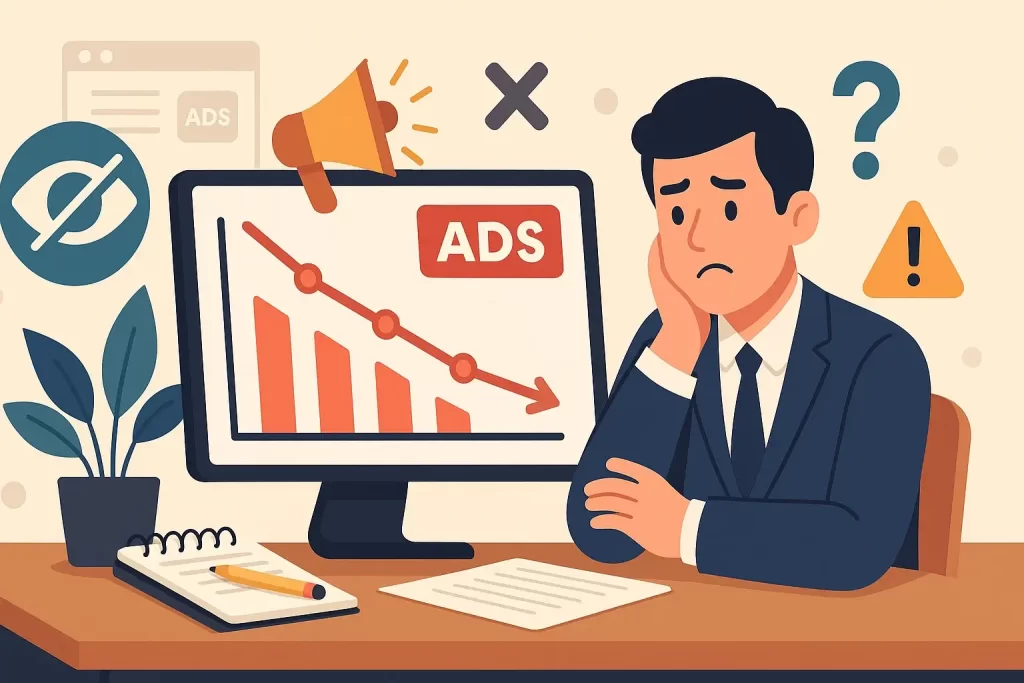
5 Reasons Your D2C Ads Are Failing
1. Failing the Platform’s Learning Phase
Most founders assume low impressions mean poor manual targeting. However, modern advertising relies heavily on algorithmic targeting (like Meta Advantage+ or Google Performance Max).
The Root Cause
If your budget is spread too thin across too many ad sets, the algorithm never gets the 50+ conversion events it needs to exit the “learning phase.” The platform restricts your visibility because it doesn’t know who will convert.
The Scaling Solution
Consolidate Accounts: Merge your micro-campaigns. Give the algorithm enough budget density to find your buyers.
Feed First-Party Data: Upload your existing customer lists to create high-intent lookalike signals, giving the algorithm a head start.
2. Ad Fatigue and Weak Hook Rates
Creative is the new targeting. If your ad creatives fail to stop the scroll in the first 3 seconds, platforms will penalize your ad visibility by increasing your CPMs (Cost Per Mille) or stopping delivery entirely.
The Root Cause
Running the same static product image or generic “Buy Now” video for months leads to ad fatigue. The audience tunes out, engagement drops, and visibility plunges.
The Scaling Solution
Track Hook Rates: Monitor the percentage of users who watch the first 3 seconds of your video. If it’s under 25%, kill the ad and test a new hook.
Rapid Creative Testing: Build a system to test 3-5 new creative variations weekly. Focus on user-generated content (UGC) and native-looking formats.
3. Misaligned Channel-Product Fit
Blindly launching a multi-channel strategy often results in high spend and zero visibility.
The Root Cause
You are forcing demand-generation ads (social media) on a product that requires demand-capture (search). If someone needs an emergency plumber, they search Google; they don’t click an Instagram ad.
The Scaling Solution
Audit Intent: Map your product to the right platform. High-impulse D2C products belong on Meta/TikTok. High-consideration or problem-solving products need Google Search or YouTube.
Unified Attribution: Use tools to track customer journeys across channels so you aren’t double-counting conversions or cutting budget from top-of-funnel channels that drive later sales.
4. Ignoring the Brand Halo Effect
Founders obsessed with immediate direct-response ROI often throttle their own scale.
The Root Cause
If you only run bottom-of-funnel conversion ads, you will quickly exhaust your warm audience. Without top-of-funnel awareness, your retargeting pools dry up, and ad visibility stalls.
The Scaling Solution
Allocate for Reach: Dedicate 15-20% of your budget to high-reach, low-cost video view campaigns.
Leverage Creator White-listing: Run your ads through the handles of established influencers. This borrows their credibility and guarantees visibility within their engaged subscriber base.
5. Manual and Sluggish Optimization
Scaling requires rapid iteration. If you are manually pausing ads and adjusting bids once a week, you are losing to competitors using automated rules.
The Root Cause
Human error and delay. Wasting money on a dying ad for 48 hours can wreck your weekly ROAS.
The Scaling Solution
Implement Automated Rules: Set up conditional logic (e.g., “If ad spends 2x target CAC with 0 purchases, pause immediately”).
Embrace Ad Tech: Use algorithmic platforms to manage bid caps and budget pacing in real time.
Automate Your Growth with Adसारथी
For lean startup teams, managing cross-channel attribution, creative testing, and automated bidding is a logistical nightmare. That’s why we built Adसारथी.
Instead of hiring an expensive agency or drowning in data spreadsheets, Adसारथी acts as your automated growth engine:
Algorithmic Targeting: Automatically routes your budget to the highest-intent audiences across Meta, Google, and display networks.
Real-Time Optimization: Built-in AI tracking instantly scales winning creatives and kills losing ads before they waste your budget.
Clear ROI Dashboards: No vanity metrics. Just clear insights on CAC, ROAS, and overall ad visibility.
Stop letting the algorithm dictate your runway. Take control of your ad visibility and scale efficiently with Adसारथी today.
Frequently Asked Questions (FAQ)
Why are my ad impressions suddenly dropping even though my budget is the same?
Sudden drops in impressions usually signal that you’ve failed the platform’s learning phase or hit ad fatigue. If your click-through rate (CTR) or 3-second video hook rate drops, the algorithm flags your creative as irrelevant and restricts your visibility to protect the user experience.
How long does it take to fix low ad visibility and see a scalable ROAS?
If you are implementing algorithmic targeting and rapid creative testing, you should see impression volume recover within 48 to 72 hours. However, stabilizing your Return on Ad Spend (ROAS) typically takes 7 to 14 days as the platform’s machine learning models adjust to your new data signals.
Is algorithmic targeting (like Meta Advantage+) better than manual targeting?
For scaling D2C brands, yes. Manual targeting often restricts visibility by siloing budgets. Algorithmic targeting pools your data and budget, allowing the platform’s AI to find the cheapest, highest-intent conversions across a broader audience pool.
How does Adसारथी actually lower CAC compared to hiring an agency?
Agencies rely on manual media buying, which is slow and prone to human error, often leaving wasted spend running for days. Adसारथी uses automated rules to kill losing ads in real-time and dynamically scales winning creatives, eliminating bloated management fees and actively driving down your Customer Acquisition Cost (CAC).
What’s Next?
In our next blog, we’ll show you how to use Adसारथी’s advanced targeting to reach your ideal audience without overspending. Stay tuned!












One Response
Very interesting topic, thank you for putting up.